25 MATH TRICKS FOR KIDS THAT MAKE NUMBERS CLICK

It’s not uncommon for kids to struggle when they begin learning math—sometimes even I still struggle as an adult! This is exactly why math tricks for kids are SERIOUS lifesavers. They take complex math problems and break them down into bite-sized, kid-friendly steps. Not only does this make the concept easier to manage, but it also makes it easier to understand.
Of course, we want our kids to thrive academically—regardless of what grade they’re in or what age they are. However, success matters more than report cards and letter grades. Being able to solve math problems efficiently is a huge boost to children’s confidence, independence, and self-assurance.
And, lucky for us parents, there are plenty of math tricks that help improve speed, accuracy, and enjoyment! Which is exactly what I’ll be exploring today. In this post, I’m sharing a handful of easy math tricks, visual strategies, and age-appropriate hacks kids can use at school or at home. You absolutely can make learning fun—and I’m here to show you how.
25 Math Tricks for Kids That Make Numbers Click
Being a parent also means being a natural teacher—and I’ve shared my favorite hacks for juggling both jobs! From “Life Skills to Teach Kids” to tips for teaching kids patience, there are so many ways to turn simple, everyday moments into meaningful learning opportunities. And that applies to math!
Math tricks aren’t just fun approaches to complex problems; they help kids build number sense and problem-solving confidence. On top of that, these quick and easy strategies help reduce math anxiety and frustration, train the brain to recognize patterns, and encourage flexible thinking.
They’re not shortcuts to math—kids will still have to learn divisibility rules, multiplication tables, and basic number concepts. Instead, they’re helpful learning tools that children can use to foster understanding and boost math fluency.
Before we dive straight into the math tricks, let’s talk about why math is important for kids. I’ll also quickly cover what you can do to make learning math feel fun!
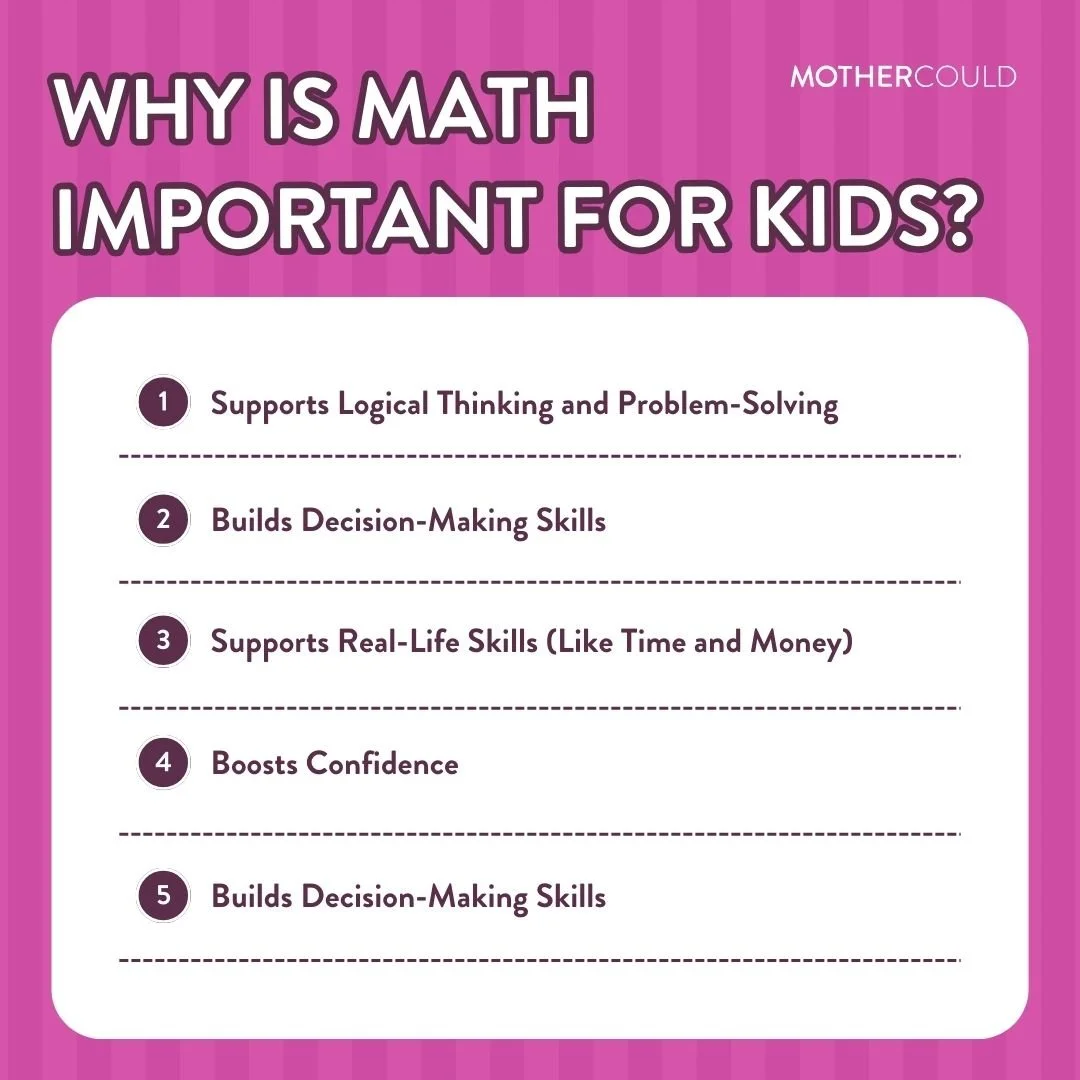
Why Is Math Important for Kids?
Supports Logical Thinking and Problem-Solving
Math helps kids learn to think through problems step by step at a pace they’re comfortable with. As they solve problems, they begin to recognize patterns, make connections, and figure out what comes next. And what do all of these actions support? Logical thinking!
Over time, those kinds of problem-solving skills carry over into everyday situations. Children begin to approach challenges knowing they can handle it; even if they need a little help from time to time.
Builds Decision-Making Skills
Everything in math relies on a foundation of decision-making. Which formula works best for a specific problem? What math trick can help solve multiplication problems more quickly? Does this word problem require addition or subtraction? Children have to make active decisions to help them find solutions.
Sound familiar? That’s what we do in life, too! When kids become confident in making decisions in math, they’re much more likely to apply those same skills outside of the classroom. From there, they become comfortable breaking down larger problems into smaller, easier steps.
Supports Real-Life Skills (Like Time and Money)
Math is integrated into so many little moments of our daily lives, many of which we don’t even think about. For kids, those moments look a little simpler, like counting their allowance or angling a ball during a sports game.
However, they’re real-life situations that they couldn’t do as successfully without basic math skills. And more times than not, these situations don’t just require math; they require logical reasoning, critical thinking, and problem-solving. It’s a beautiful blend of skills that math helps develop naturally over time.
Boosts Confidence
Kids love doing things on their own, but this is no surprise! Infants try to hold spoons, toddlers want to dress themselves, and younger children begin brushing their own teeth. That confidence boost comes when they do something right, even if it takes them a little while to get there.
Math isn’t particularly an easy concept—it’s a lot of trial and error! However, that’s a huge part of fostering confidence. When kids break down complex challenges into manageable tasks, those “small wins” turn into “I can do it!” moments. Over time, they begin to associate mistakes with learning opportunities—not failures.
Encourages Independence
Fostering independence is such a crucial aspect of parenthood—which is exactly why I wrote a book all about it! In Playful by Design, I explore how, as my kids became more independent, they began to feel happier, more energized, more fulfilled, and more connected. While I reference this regarding dedicated play spaces and intentional activities, it absolutely applies to mathematical concepts as well.
Math isn’t all multiplication tricks, subtracting digits, adding fractions, or dividing decimals. It’s also managing money, telling time, adjusting ingredients, and counting steps. And when kids can successfully navigate these everyday math moments on their own? It builds confidence, autonomy, and a sense of purpose.
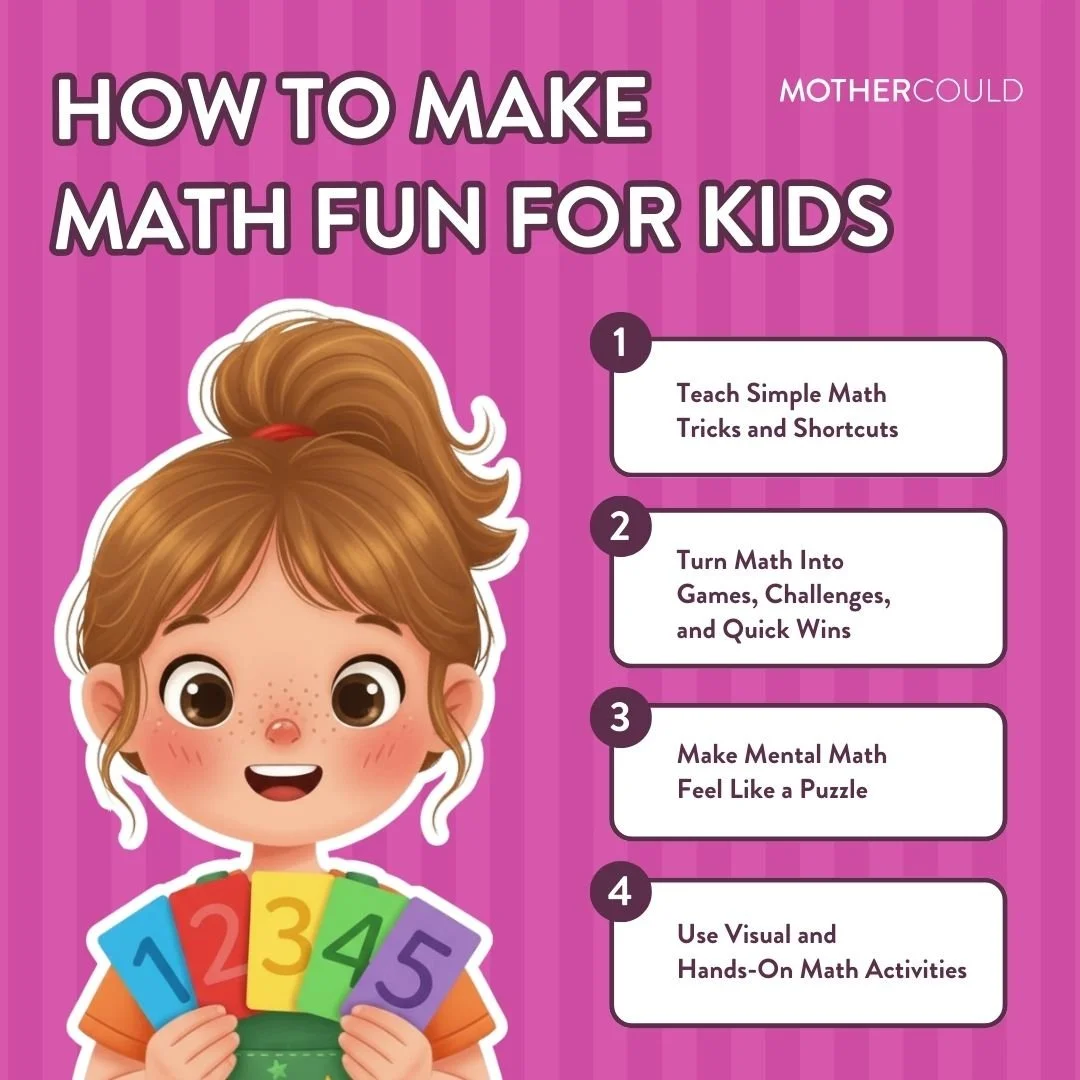
How to Make Math Fun for Kids
Teach Simple Math Tricks and Shortcuts
Math tricks, math magic, clever math shortcuts—call them whatever you’d like! But when you use this kind of language, it sparks curiosity and intrigue. Kids forget they need to multiply large numbers or add fractions because the focus shifts to solving a puzzle rather than completing a task.
And when they begin to truly learn those tricks? Math loses a little bit of its complexity. Fast, “magical” solutions make them feel accomplished, secure, and ready to take on the next task.
Turn Math Into Games, Challenges, and Quick Wins
When you turn math into a game, you quietly remove the pressure and fear of failure. Instead of getting discouraged by getting an answer wrong, kids will feel comfortable trying new strategies until they find the right one.
And there’s no one-size-fits-all approach here! You can play Uno to practice number recognition, or Monopoly for adding money. You can implement the benefits of sensory bins by hiding 3D numbers for children to find under texturally engaging materials. Or, you can create a math-themed scavenger hunt, encouraging kids to solve problems before moving on.
Find an activity your littles enjoy and turn it into a math lesson—they won’t even realize they’re learning!
Make Mental Math Feel Like a Puzzle
You know that feeling when something just finally clicks? It’s the BEST—and so is that silent confidence boost that comes with it. This is exactly how kids feel when you turn mental math into a puzzle. Instead of just memorizing rules and listening passively, children learn to analyze, plan, and try different solutions.
Instead of thinking “What’s the right answer?”, their mind shifts to “What’s the easiest way to solve this?” And that difference matters. Over time, kids begin to successfully manage number sense without getting stumped (or frustrated!).
Use Visual and Hands-On Math Activities
Right now, simple math is an abstract concept to most children. They understand that it means something; they just don’t know what. But when you use visual and hands-on activities to teach math, you make the idea concrete and relatable!
Take playdough math activities, for example. As children manipulate the material, they’re able to “see” the math, making it feel more engaging and attainable. In fact, research shows that children using visual representations are six times more likely to correctly solve a math problem. That’s a BIG deal!
Want a few other fun ways to practice math? Check out my Back to School Activity Pack! With over 80 pages of activities, kids can practice writing skills, numbers, math, and more.
25 Math Hacks for Kids
Addition and Subtraction Hacks
Start Adding By Bigger Numbers:
If the math problem is “15 + 5,” always start with the bigger number. Instead of counting up from 5, add 5 to 15. It doesn’t take nearly as long, and it’s much easier to understand!
Break Down Bigger Numbers:
Kids are much better at adding large numbers when you break them down into smaller, bite-sized pieces. Want to make it even easier? Split numbers into tens and ones to simplify addition.
Example: 47 + 10 → (40 + 30) + (7 + 2)
It feels like this trick complicates things, since you’re now dealing with two problems rather than one. But for kids, it makes a complex equation feel much easier to navigate.
Subtract Each Number From 100 (All From 9, Last From 10)
This one sounds tricky in theory, but it makes subtraction SO much easier. For a problem like 100 - 63, you don’t subtract everything at once. Instead, subtract the first digit from 9 and the last digit from 10. It will look like…
Example: 9 - 6 = 3
10 - 3 = 7
Put those numbers together to get 37, which is… drumroll, please! The answer to 100 - 63. Once you get the hang of it, you’ll never teach subtraction another way.
Count Up Instead of Counting Down
Did you know that you can find the answer to a subtraction problem by counting up? Seems counterintuitive, but it’s true!
Example: 13 - 9 → count up from 9 to 13.
Kids learn to count upwards from a young age, which naturally makes subtraction harder. When you reverse the direction, you’re reducing their cognitive load and working with processes they’ve already mastered!
Multiplication Shortcuts
Finger Trick for 9s:
If you haven’t heard of this trick yet, prepare to be amazed by math magic. Hold out both of your hands and assign each finger a number from 1 to 10. The left pinky is 1, the right pinky is 10. Now, fold down the finger that’s being multiplied by 9.
Example: 9 x 4 = 36
You’ll have three fingers up on the left side of the bent finger, and six fingers up on the right. There’s your answer!
Multiplying by Ten:
Multiplying another number by 10? Just add a 0 to the end of the other number. It makes multiplying double-digit numbers a piece of cake.
Example: 7 x 10 = 70 or 120 x 10 = 1200!
The 6s Trick:
I have to admit, I use this trick myself often! Whenever you multiply 6 by an even number, the last digit of the answer will end in the last digit of the number you multiplied by.
Example: 6 x 8 = 48; 6 x 12 = 72; 6 x 172 = 1032
You may still have to pull out the multiplication tables, but it’s helpful to know the last digit in advance.
Dance Counting Trick:
Most of us know that 7 x 8 = 56… but how? Our brains think of it as a short number sequence. When teaching this trick to kids, simply count like you’re getting ready to dance: 5, 6, 7, 8!
Hide and Seek:
If a number ends in 0 in your equation, play hide and seek! Just multiply the other digits (hide), and add them back in after your child has their answer (seek).
Example: 40 x 600 → 4 x 6 = 24. Now add in those hidden zeros to get 24,000
This trick works for everything from single-digit to ten-digit equations.
Division and Fraction Helpers
Divide Even Numbers in Half:
One of the easiest ways to divide even numbers is by using a halving trick. When diving by 2, you can split the number in half to find your answer!
Example: Dividing half of 48? (4 ÷ 2 = 2) (8 ÷ 2 = 4). Your answer is 24!
The method also helps when you’re dividing by 4 or 8—just halve the number again for each step.
Use Multiplication Tables:
Another trick that seems a little counterintuitive but works like a dream. Simply use a multiplication table to reverse a division problem.
Example: If 5 x 6 = 30, then 30 ÷ 6 = 5.
Same Bottom Numbers:
In fractions, seeing the same denominators truly feels like a blessing in disguise! In this case, you just have to add or subtract the top numbers.
Example: ⅖ + ⅕ = ⅗ or ⅗ - ⅖ = ⅕
Flip to Divide:
Fractions and diving in one equation? Feels tricky! Until you realize all you have to do is flip the second fraction and multiply.
Example: ½ ÷ ¼ → ½ x 4/1 = 2
Butterfly Method:
To add fractions with different denominators (bottom numbers), just cross-multiply! Or, as I like to call it for a kid-friendly alternative, butterfly it.
Example: ⅕ + ⅔ → (3 x 1 = 3) (2 x 5 = 10) → (3 + 10 = 13). 13 is your numerator. Now multiply the denominators (3 x 5 = 15). Your answer is 13/15!
Multiples of 9
Remember that funky finger trick we learned earlier for multiplying 9? It also works for division. Think of it this way: in a math problem, if the sum of the digits is divisible by 9, so is the original number!
Example: If the number is 486, 4 + 8 + 6 = 18. Since 18 is divisible by 9, 486 is, too.
Number Patterns and Estimation
Check Even and Odd Numbers by Last Digit:
Here’s an easy one! When your kid is working on odd and even numbers, simply look at the last digit. If a double-digit number ends in an odd number, then it’s odd—same for even numbers.
Example: 3,763 is odd. 762 is even.
Look for Skip Counting:
Skip counting is an excellent mental math trick to teach early on. 10s will always end in 0s, so it’s almost the same as counting by 1s. Same for 5s, they’ll always end in either a 5 or a 0. And 2s will always be even. Skip counting works SO well for quick answers!
10 Consecutive Numbers:
This math trick is so fun—and you won’t hear many people say that often! Whenever you have 10 consecutive numbers, just add “5” to the 5th number in the sequence.
Example: 132 + 133 + 134 + 135 + 136 + 137 + 138 + 139 + 140 + 141 = 1365
Fascinating, right?! You’ll be glad you have this up your sleeve as math concepts become trickier. (Looking at you, algebra!)
Round to the Nearest Ten
When you’re estimating big numbers, rounding to the nearest ten makes them much easier to work with.
Example: Round 48 to 50, or 142 to 140.
If the last digit is less than 5, round down to the nearest zero. If the last digit is larger than 5, round up to the nearest zero.
Use Benchmarks:
Odd numbers can feel hard to estimate, especially for kids new to math. Try rounding it up to familiar even numbers to make estimating quicker and easier!
Example: 73 is closer to 50 than 100. 23 is closer to 10 than 50!
Takes a little getting used to, but it really comes in handy when numbers and equations start getting larger.
Mental Math Tricks for Kids
Round First, Then Adjust:
This is another one of those tricks that feels like it complicates things, but it really doesn’t. Instead of working with odd numbers, round them up and adjust afterwards.
Example: 29 + 21 → 30 + 20 = 50, then subtract 1 → 49
Splitting Numbers:
Breaking numbers up into tens and ones actually makes working out bigger problems easier! Especially in situations where kids may not have access to pen, paper, or calculators.
Example: 47 + 12 → (40 + 10) + (7 + 2) = 59
You’re still working with the same numbers; you’re just simplifying that process by adding whole numbers and single digits.
Doubling for Addition
Sometimes multiplying small numbers is easier than sitting there and counting on your fingers.
Example: 14 x 2 = 28 rather than 2 + 2 + 2 + 2 + 2 + 2 + 2 + 2 + 2 + 2… Need I go on?
For kids, this trick definitely works better on smaller numbers. Things get a little complex with too many digits!
Group Numbers:
Another easy mental math trick for addition! When you’re adding sequences of numbers, group digits together that add up to 10 (or another friendly number), then add what’s left.
Example: 8 + 7 + 3 → (7 + 3 = 10) + 8 = 18
This way, kids don’t have to count each number individually. Instead, they can combine numbers that make 10, 20, 30, etc., then add the remaining number at the end.
Double One, Halve the Other:
You can use mental math for multiplication! You just have to make the problem easier by doubling one number and halving the other.
Example: 25 x 4 → double 25 to 50, halve 4 to 2 → 50 x 2 = 100
You still get the same answer, it just makes the math itself a lot easier.
Math feels a whole lot easier to teach—and learn—with these kid-friendly math tricks.
It’s no secret that teaching math is one of the more difficult things we have to do as parents. However, most kids naturally feel the same way about learning! Numbers get bigger, equations become longer, and solutions feel a little trickier. However, these math tricks make finding solutions a little less stressful and a lot more enjoyable.
And remember, math is incredibly beneficial for teaching things like confidence, problem-solving, and independence—everything I discuss in Playful by Design! Available in multiple formats, let this book be your guide to stress-free, exciting parenting tips. From enriching self-directed play to intentional play spaces, say goodbye to constant overwhelm and hello to joy, creativity, and balance. Looking for more ways to support your child’s development? Here’s how to teach kids healthy study habits.
Looking for more ways to teach your kids important life, academic, or developmental skills? Head over to the Mothercould blog for endless resources on thoughtful play ideas and activities. (And maybe a fun gift guide, or two!) And, of course, make sure to join the Mothercould In Your Pocket resource. You’ll gain instant access to 60+ printable recipes, guided tutorials, and helpful how-to videos!