
10 Letter Activities for Preschoolers Made Simple and Fun
When it comes to childhood development, teaching preschoolers early literacy skills can make such a noticeable impact. More specifically, letter recognition and letter sounds are both foundational in early childhood; they’re what help kids learn to read, write, and enhance cognitive skills! The secret to teaching those skills in a fun, engaging way? Letter activities.
Each time your preschooler reads the letters on a cereal box, sings the alphabet, or recognizes the first letter of their name, they’re practicing their own version of letter activities. Children are natural little learners! However, imagine how much you could support their curiosity with age-appropriate activities designed specifically to build letter recognition and letter sounds.
You’re in luck, because that’s exactly what I’m sharing today! In this post, you’ll find some of the best letter activities for preschoolers that make learning feel playful, exciting, and approachable. I’ll also explain why letter recognition is important and share simple tips for helping your child build those early literacy skills right at home.
10 Letter Activities for Preschoolers Made Simple and Fun
It can feel like there are a lot of little elements to literacy skills—I get it! You have to teach kids how to spell, figure out exciting ways to teach the alphabet, and somehow still make learning fun! While overwhelming at first glance, that’s one of the many beautiful parts of parenthood. We’re raising confident, capable, and independent little learners!
The key to making it all feel manageable? Teaching new skills in ways that are age-appropriate, playful, and developmentally aligned. Preschoolers in particular learn best through play and repetition, which is why choosing activities that prioritize that is important!
And that’s exactly what we’ll be doing in this post. First, I’ll cover what letter activities are and why letter recognition is so important. Then I’ll explore the best ways to teach letter sounds to preschoolers and share activities to help you through the process.
What Are Letter Activities?
Letter activities are structured or play-based tasks that help children recognize, name, write, and associate letters with sounds. These activities support early literacy by making alphabet learning interactive, engaging, and developmentally appropriate for preschoolers.
We’re not shoving a piece of paper in front of them and asking them to memorize letters, though. The best way children learn is when they can see, hear, and physically interact with what they’re learning. That’s exactly why effective letter recognition activities combine multiple learning styles!
For example, preschoolers might trace letters in salt or shaving cream with their fingers. Or maybe they’ll sort squishy objects and bright colors that begin with a specific letter. See how we’re combining sensory processing elements here? When children experience letters through visual, auditory, and kinesthetic learning, it strengthens memory retention. AKA, the information children learn actually sticks—not just goes in one ear and out the other!
The goal isn’t perfection; it’s repetition and exposure. The more opportunities children have to interact with letters in meaningful ways, the more naturally they’ll begin to recognize them and connect them to sounds. Over time, those small moments lay the foundation for reading, writing, academic success, and a lifelong love of learning.
Why Is Letter Recognition Important for Preschoolers?
Letter Recognition Builds Strong Decoding Skills
Decoding skills, which allow children to translate printed letters into spoken sounds, are extremely important. This is the skill that helps kids begin reading more fluently and with less frustration. Instead of guessing at words, children learn how to sound them out, blend sounds together, and gradually turn reading into a more automatic process.
Letter recognition plays a crucial role here. Before children can decode words, they first have to learn the letters that make up those words. Over time, rather than stopping at every single letter while reading, their brains begin to naturally recognize patterns and sounds. It’s all one seamless, fantastic process!
Knowing Uppercase and Lowercase Letters Makes Reading Easier
As kids begin to identify both uppercase and lowercase letters, it becomes much easier to recognize sentence structure. Essentially, children go from reading a single, run-on sentence to distinct, cohesive sentences. They’re able to successfully understand sentence beginnings, names, and proper names.
Letter and alphabet activities foster this skill by focusing specifically on letter formation. Think: knowing the difference between “A” and “a,” or “G” and “g.” They’ll begin to understand that while they may sound the same, they indicate different things. And that simple understanding translates into becoming a better reader, writer, and speller.
Strong Letter Knowledge Boosts Confidence in the Classroom
As parents, we all hope our children feel happy, confident, and capable in the classroom. One of the best ways we can support that is by helping them build strong literacy skills early on. When children recognize letters and understand their sounds, they’re much more likely to participate in classroom activities and feel proud of doing so.
And, as I discuss in my book, Playful by Design, confident kiddos become independent kiddos. And a sense of independence is one of the best gifts we can give to our children. If you’re interested in learning more, Playful by Design is available in physical, e-reader, and audiobook formats!
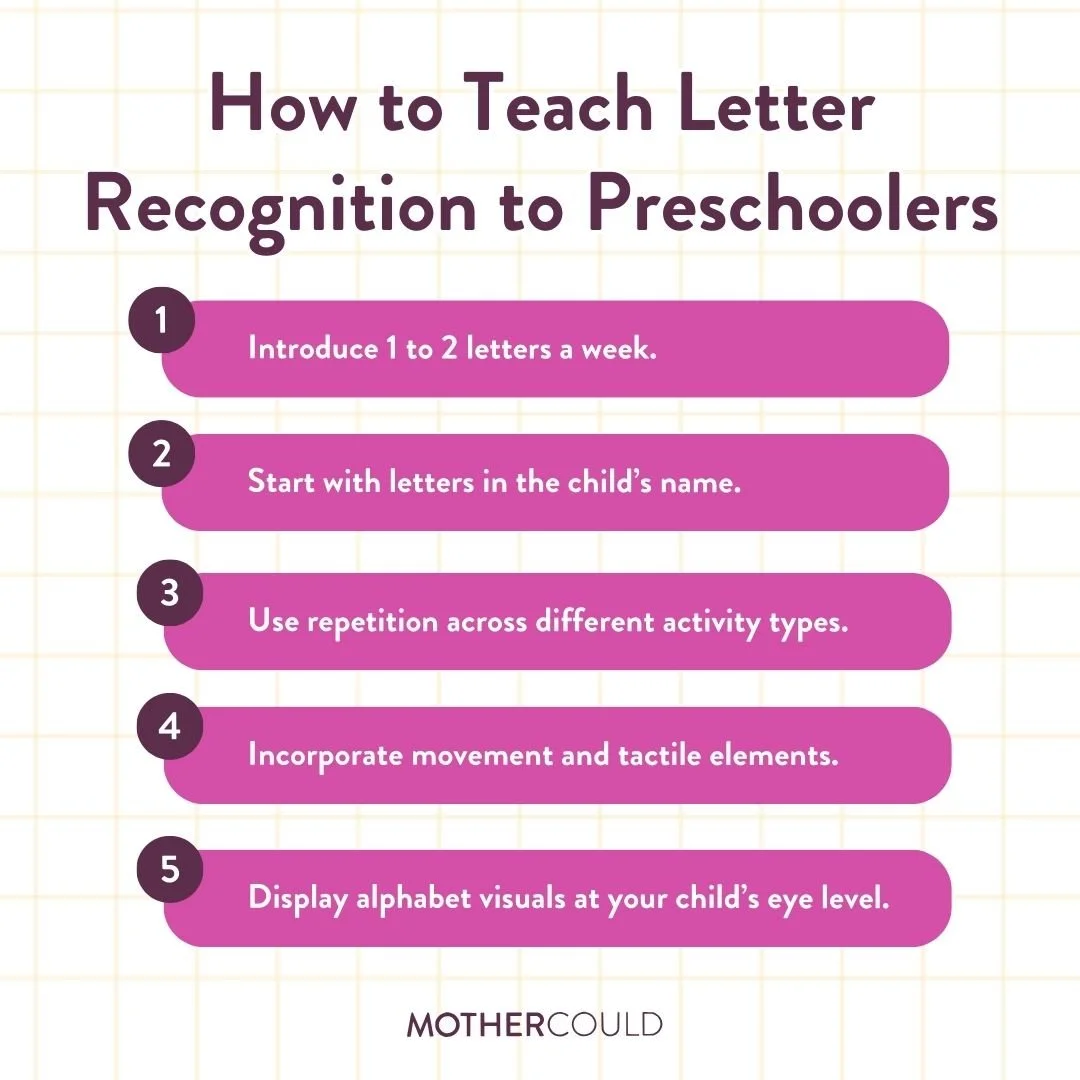
How to Teach Letter Recognition to Preschoolers
Introduce 1 to 2 letters a week.
Teaching your children letter recognition skills is exciting! However, slow and steady wins the race. To prevent cognitive overload, which is when the working memory basically says, “I can’t take anymore!”, stick to 1–2 letters at a time. This is what research refers to as “letter cycling.”
This approach allows preschoolers to become comfortable with each new letter, reducing confusion and encouraging long-term retention. Then, once they have those letters down, you can move on to the next set!
Start with letters in the child’s name.
More often than not, a child’s name is one of the first words they truly understand. Pretty neat, right? And it makes perfect sense! It’s the word that they’re constantly exposed to, from bedroom artwork to pre-k cubbies. As we know, children are naturally more motivated to learn things that feel personal to them.
That said, teaching letter recognition activities by using your child’s name is an excellent way to start. Instead of simply practicing letters, kids are exploring something that belongs to them.
Use repetition across different activity types.
Regardless of what skill you’re teaching, repetition is the tool that makes things click. The more you repeat something, the more you help strengthen neural connections in the brain. Suddenly, new concepts transform into automatic habits!
And in letter recognition, constant repetition encourages new letters to move from short-term memory to long-term memory. This is when you’ll see a burst of development as children begin to instantly (and confidently!) recognize letters.
Incorporate movement and tactile elements.
In my post about five senses arts and crafts, I talked all about how children use their five senses (sight, sound, smell, taste, and touch) to learn about the world around them. The more they can engage with a concept, the more they can store and retrieve information.
In fact, a recent study even proved this! It found that children who participated in just 10 minutes of fine-motor-enriched activities were able to distinguish between “b” and “d” more efficiently than children who didn’t. This is why keeping learning experiences hands-on and sensory-rich really does pay off!
Display alphabet visuals at your child’s eye level.
Think about it: if you were learning something new at work but the presentation was five feet above your head… would you be paying attention? You may try to, but it wouldn’t be easy! The same concept goes for teaching children letters.
When you keep the material at your child’s eye level, you’re encouraging them to actively engage with what they see. Instead of being something they only notice during structured learning time, letters become part of their everyday environment!
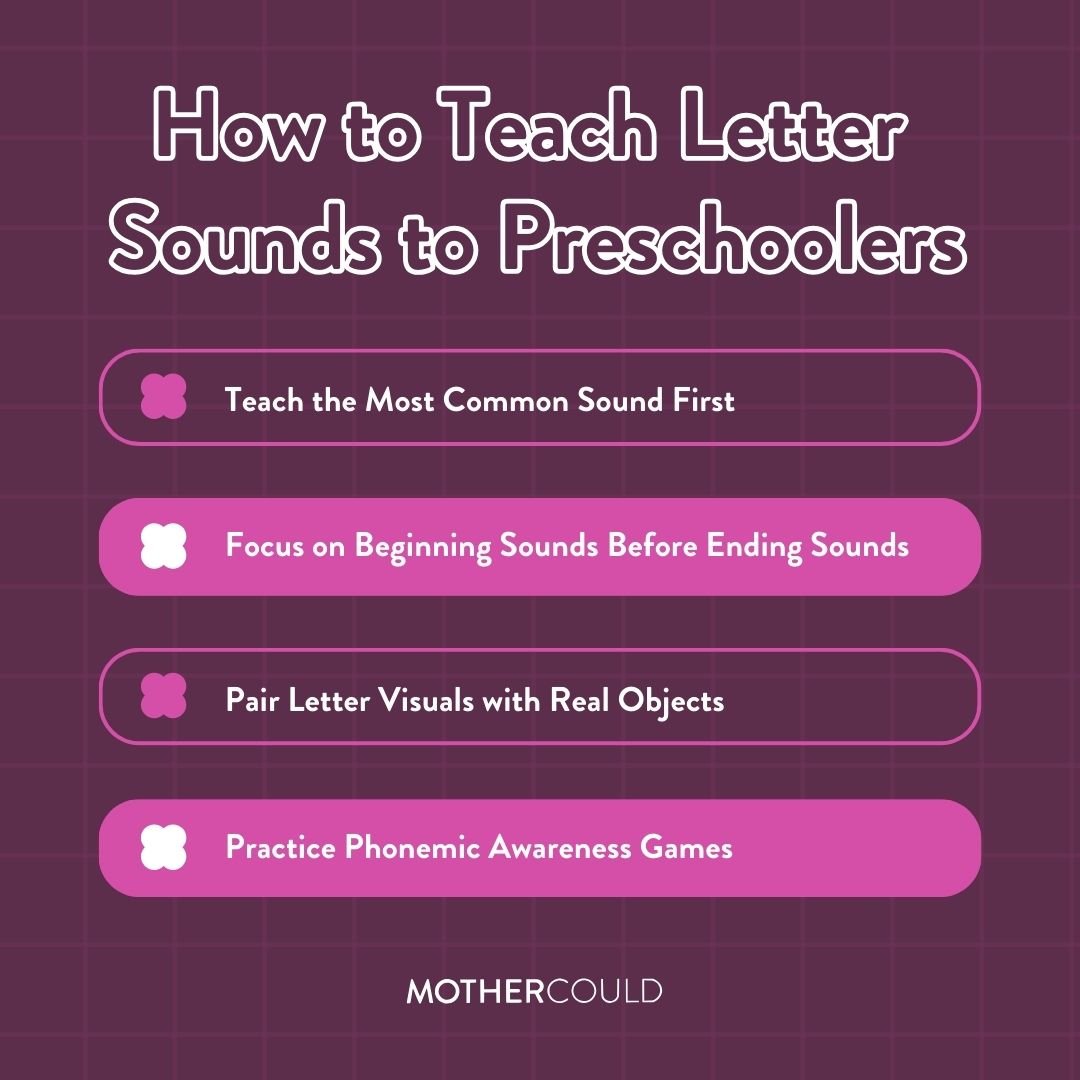
How to Teach Letter Sounds to Preschoolers
Teach the Most Common Sound First
When you’re teaching letter sounds to preschoolers, start with the easiest, most common sounds first. Some letters can make more than one sound, like C, for example! When you’re teaching kids to sound out the letter C, start with the softer “s” sound, not the “k” sound. Begin with words like circle, center, or bicycle, and save words like camera and cup for later.
This helps children build confidence, reducing confusion since they’re still learning how letters connect to sounds. Once they feel comfortable identifying the basic sound of each letter, then you can gradually introduce more complex pronunciations!
Focus on Beginning Sounds Before Ending Sounds
Children don’t read letters from right to left; they’re (generally) not taught to! That said, teach them letter sounds just like you’d teach them words: from beginning to end. This is exactly why most literacy activities prioritize learning the first sound in a word. It’s easier!
When a preschooler learns the beginning of the word, they’re more likely to feel confident breaking harder words apart. “Ball” becomes “Ba-” and “-ll.” “Outside’ becomes “out-” “-si” “-de.” That simple approach is an important early step to more efficient reading and spelling!
Pair Letter Visuals with Real Objects
Multisensory experiences are what encourage children to turn abstract ideas into tangible concepts. When you do this, in a preschooler’s mind, a letter isn’t just a letter anymore; it’s a real-life object! A perfect example of this is handing your child an apple when you’re teaching the letter A.
They slowly begin linking the visual letter to its sound, which is the exact moment the letter gains meaning!
Practice Phonemic Awareness Games
Let’s quickly break something down. Phonemes are what you hear; graphemes are the letters you see that represent those sounds. And when you’re teaching preschool letter sounds, it’s all about the phonemes!
Play-based learning is one of the most effective ways to teach preschoolers new skills. And simple phonemic awareness games are lifesavers here! Sorting objects by their beginning sounds or playing “I Spy” with letter sounds helps children retain that information in a fun, accessible way.
Those playful connections also strengthen listening skills, helping kids become more comfortable recognizing how sound works in spoken language.
10 Letter Identification Activities for Preschoolers
Preschool Letter Recognition Activities
Alphabet Activity Pack
Even if your little one isn’t old enough to write yet, this screen-free Printable Alphabet Activity Pack is a great introduction to letters! With over 15 pages of activities, you can practice matching uppercase and lowercase letters, fill in missing letters in the alphabet soup, and more!
Find the Letter Activity
This Find the Letter activity is an extremely exciting way to practice letter recognition. Think of it as an alphabet hide-and-seek! Just sneak some 3D letters into colorful rice and ask your child to identify each one they scoop out. Excellent for motor skills and memorizing the letters.
Pom Pom Letter Reveal
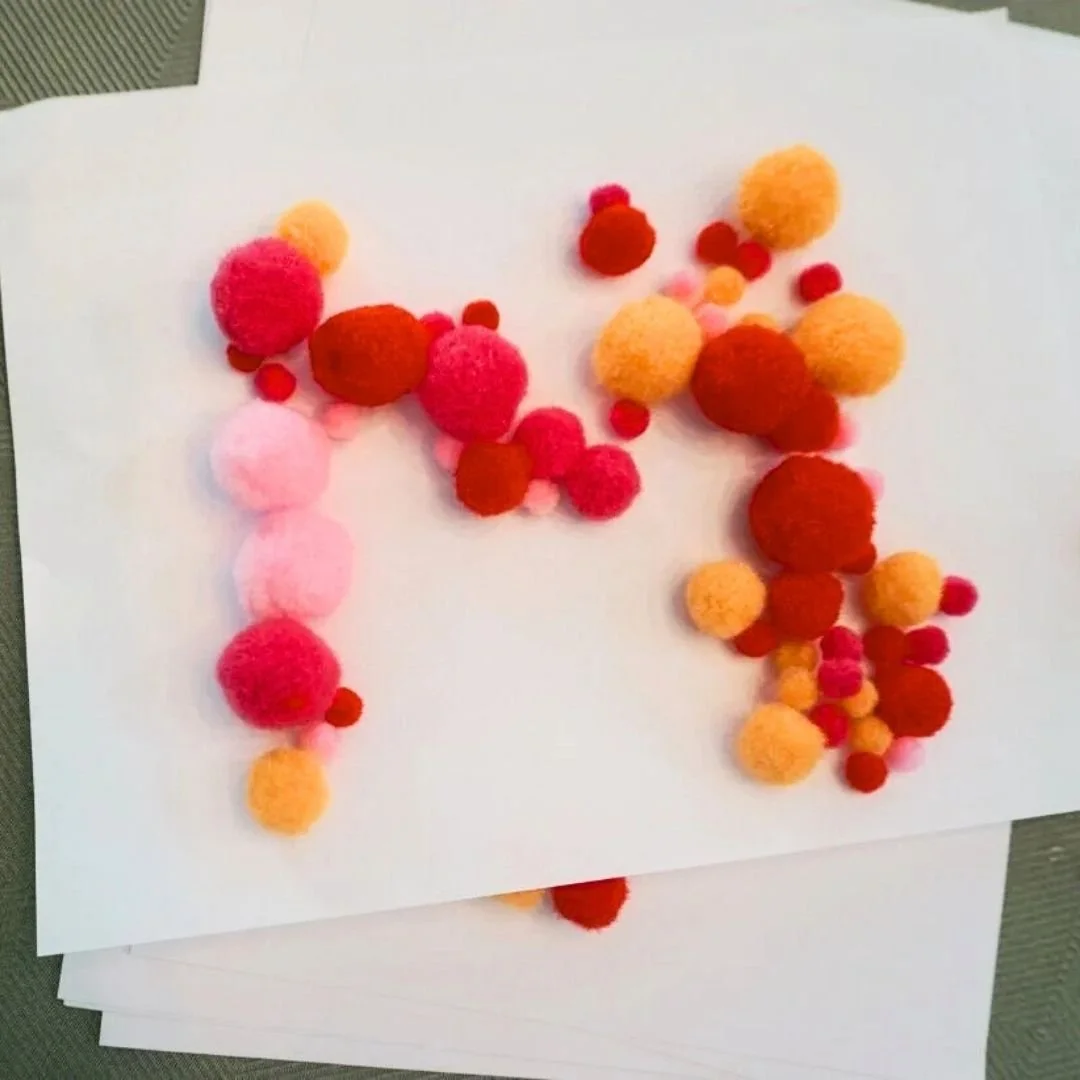
If your kiddos can’t yet write letters, you may have to help out with the beginning. Just draw a letter on a piece of white paper using double-sided tape, fill the page with colorful pom-poms, and turn the page over to reveal the hidden letter underneath. The Pom Pom Letter Reveal activity never fails to encourage excitement as the letters “magically” appear!
Salt Dye Letter Tray
Tactile and sensory-rich, this Salt Dye Letter Tray is fantastic for letter tracing. Simply just write a letter on a sheet of paper, place it next to the tray, and ask your child to trace that same letter in the salt. The gritty texture makes things all the more engaging!
Letter Hop
What better excuse to get outside than to practice letters? Trace a hopscotch pattern, write different letters in each box, and ask your child to shout out the letters they land on. Don’t forget your SPF and your Premium Sunscreen Brush Set before heading outdoors!
Preschool Letter Sound Recognition Activities
Alphabet Scavenger Hunt
This activity in my Mothercould In Your Pocket resource is always a hit when I’m teaching letter sounds! Just print off the page and ask your kids to bring it around the house as they find something that starts with each letter of the alphabet. Not only is it great for learning how to pronounce letters, but it’s fantastic for building phonemic awareness!
Complete the Letter
Grab a white sheet of paper and write half of an uppercase letter on it. Yes, just half! Then ask your child to complete each letter with a piece of colorful spaghetti, sounding out the letter when they’re done. Nothing keeps a child engaged like a slimy, squishy material!
Beginning Sound Sorting
Label cups, baskets, or trays with 3–5 different letters. Then, give your child a handful of small objects. Think: bouncy balls, pom-poms, or mini squishy fruit figures! Next, ask them to place each object in the labeled cup it belongs to based on the beginning sound.
“Bouncy balls” would go in the cup labeled “B.” A squishy grape goes in the cup labeled “G.” You get the gist! It’s excellent for practicing pronunciation and building early decoding foundations.
I Spy Sounds
Who doesn’t love a classic game of I Spy? But in this version, instead of focusing on colors, we’re focusing on letter sound recognition. It’s as simple as saying, “I spy something that starts with the letter C.” It keeps phonemic awareness playful and exciting!
Sound Parking Lot
This activity is so cute, and kids will be entertained for hours. Start by drawing parking spaces labeled with letters on a craft paper roll. The more space, the more letters you can practice! Kids can then “park” objects in the space that match the letter’s sound.
With these versatile letter activities, teaching preschoolers letter recognition and letter sounds has never been easier!
When you’re teaching a tiny human the tools they need to begin speaking, it doesn’t always feel easy! You have to worry about letter formations, how words sound, and how to make concepts feel more approachable and accessible. Here’s the good news: play-based learning makes it easy! With age-appropriate activities, you can meet children exactly where they are—mentally and developmentally.
Among many other things, learning letters is one of the most important factors of independence. And as I discuss in my book, Playful by Design, independence is truly the gift that keeps on giving. It’s what encourages children to engage in self-directed play, feel more confident, and allows parents a second to catch their breath. And all you need is a little time, patience, and structure. Order Playful by Design to learn more!
As challenging as parenthood can feel, you don’t have to navigate it alone. On the Mothercould In Your Pocket resource, you can find 60+ printable recipes, guided play tutorials, printable activity packs, and more. Join to gain access today! Want even more? Head over to the Mothercould blog! I post kid-friendly recipes, sensory play activities, my Weekly Favorites, and helpful Holiday Gift Guides.
With the right community, tips, and tricks, parenting has never felt easier. See you in the next post!